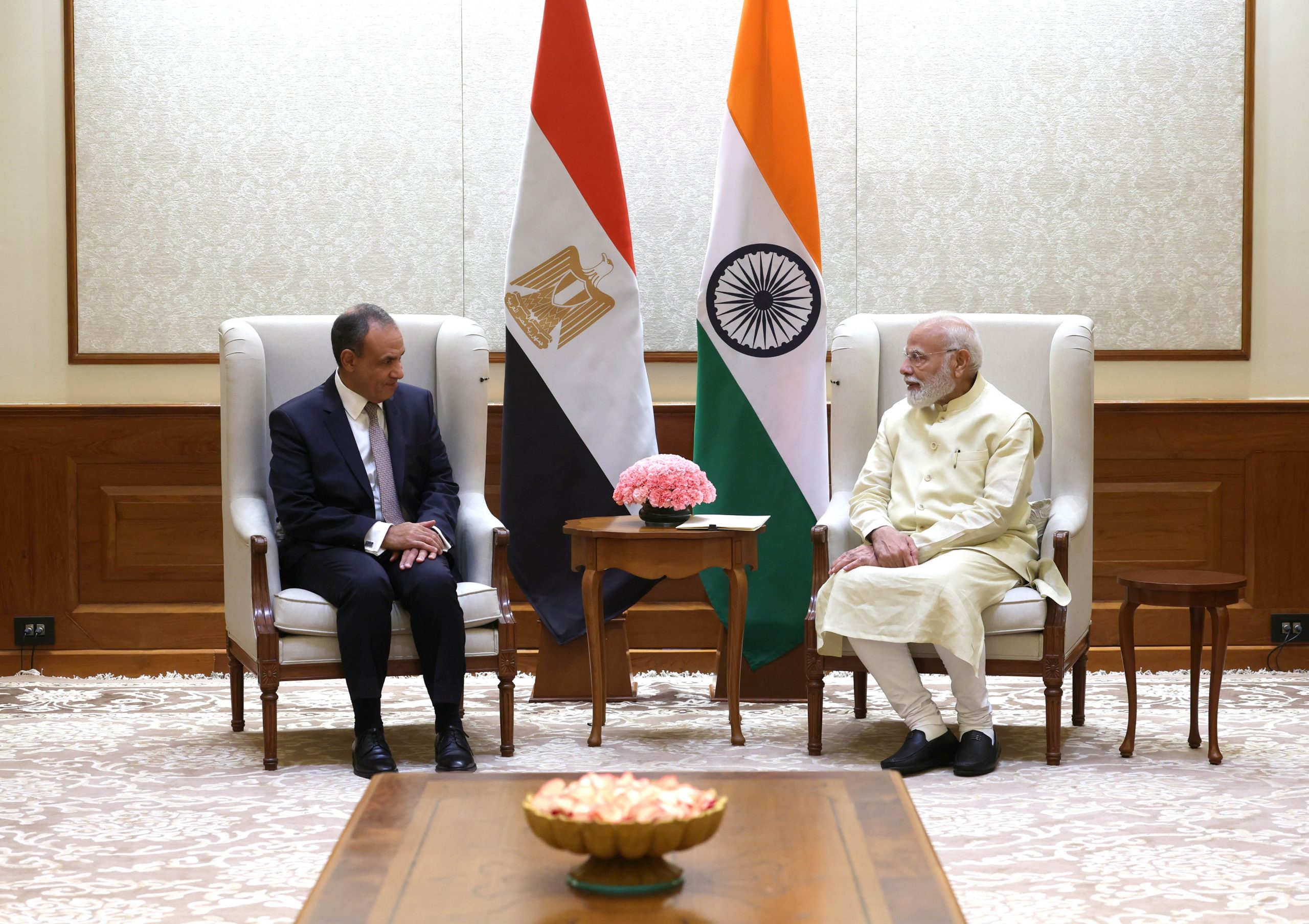
NEW DELHI: Egypt’s Foreign Minister Badr Abdelatty’s recent visit to India was not just another diplomatic engagement, it was a strategic statement linking peace, politics, and prosperity across continents.
Speaking in New Delhi during the inaugural India–Egypt Strategic Dialogue, Abdelatty emphasized that no regional economic vision, including the India–Middle East–Europe Economic Corridor (IMEC), can succeed without first resolving the Palestinian question.
The IMEC – a U.S.-backed initiative unveiled at the G20 Summit in 2023 seeks to connect India with Europe via the UAE, Saudi Arabia, Jordan, and Israel, integrating sea and rail networks to boost trade and industrial growth. But as Abdelatty noted, “Connectivity is very important as part of a final settlement of the Palestinian cause. The IMEC is an important project, but peace and justice must come first.”
His remarks came as Egypt, grappling with Red Sea disruptions and regional instability, pushes for a more balanced global order that merges diplomacy with development. The Houthi attacks on commercial vessels carried out in the name of Palestinian solidarity have reduced Suez Canal crossings by up to 60%, costing Egypt over $9 billion in losses. For Cairo, the message is clear: trade routes cannot flourish amid turmoil.
Abdelatty’s talks with External Affairs Minister Dr. S. Jaishankar reflected a renewed urgency to deepen cooperation across multiple fronts, from traditional industries like fertilizers and pharmaceuticals to high-tech sectors such as AI, digitalization, renewable energy, green hydrogen, and Industry 4.0.
Currently, about 55 Indian companies operate in Egypt, but Abdelatty urged for “hundreds more,” citing Egypt’s investment-friendly climate and the proposal to establish an Indian industrial zone in the Suez Canal Economic Zone.
The visit also underscored Egypt’s intent to strengthen defense, counterterrorism, and capacity-building ties with India. Both nations agreed to increase high-level visits, with Jaishankar expected in Cairo in early 2026, to sustain the momentum of the newly elevated strategic partnership first agreed by President Abdel Fattah el-Sisi and Prime Minister Narendra Modi in 2023.
On Gaza, Abdelatty welcomed India’s participation in the Sharm El-Sheikh Peace Summit, where world leaders gathered to discuss post-war stabilization. He called for a UN Security Council resolution to authorize an international stabilization force in Gaza and empower Palestinian security institutions to govern and rebuild. “We need an effective mechanism that ensures stability, reconstruction, and dignity for the Palestinian people,” he said.
Beyond bilateral ties, Egypt’s outreach to India signals a broader geopolitical recalibration. Cairo envisions India not merely as an economic partner but as a co-architect of multipolar stability, a partner that can engage the Middle East without polarization. The two countries’ alignment on digital transformation, green growth, and South-South cooperation positions them as key players in bridging Asia, Africa, and Europe.
In the evolving landscape of global trade, Egypt’s message is both pragmatic and profound: economic corridors like IMEC will remain incomplete without peace in Palestine and stability across the Red Sea. For India, this is both a challenge and an opportunity to expand influence in the Middle East while anchoring its rise in diplomacy rooted in inclusivity and balance.
As Abdelatty concluded, “India is a rising strategic partner. Our cooperation from trade to technology, from peace to prosperity will help shape a more balanced global order.”
– Dr. Shahid Siddiqui | Follow on X @shahidsiddiqui