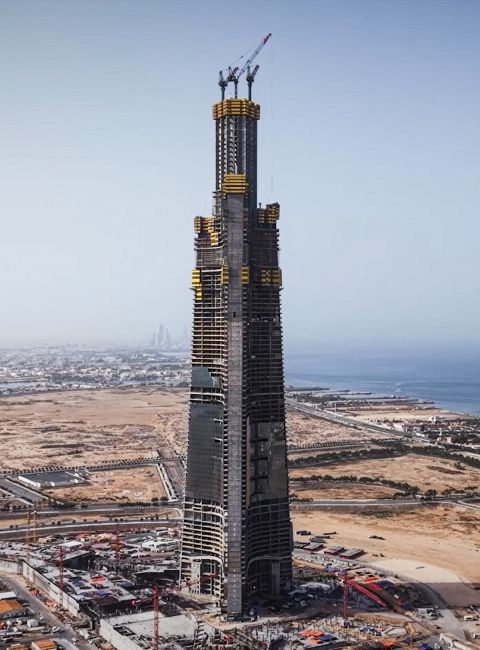
Saudi Arabia’s Jeddah Tower has crossed one of its most important construction milestones yet, strengthening its bid to eventually replace Dubai’s Burj Khalifa as the world’s tallest completed building.
The latest progress update shows that Jeddah Tower has reached 430 metres and 106 levels. That puts the structure above half the height of the 828-metre Burj Khalifa, although it is still less than halfway toward its own planned height of more than 1,000 metres.
For a project that spent years largely frozen, reaching this point carries more significance than another completed floor. It demonstrates that construction has returned to a sustained pace after its long period of uncertainty.
And there is still a long way to go.
If completed according to its design, the tower will rise more than one kilometre above Jeddah, beating Burj Khalifa by at least 173 metres and creating the first completed building on Earth to break the kilometre barrier.
Jeddah Tower Reaches 430 Metres and 106 Levels
Kingdom Holding disclosed the latest milestone in its second-quarter 2026 results, reporting that the tower had reached 106 levels and a height of 430 metres.
More than 300,000 cubic metres of concrete have now been poured for the development. That represents roughly 67% of the concrete planned for the tower, according to the latest project figures.
Around 6,400 workers are currently deployed at the Jeddah site.
The latest update also shows that construction is moving beyond simply pouring the tower’s concrete frame. Mechanical, electrical and plumbing work is progressing, while more than 3,000 façade panels have already been installed.
That is important because completing a skyscraper of this scale involves far more than reaching the final structural level. The building must eventually be enclosed, fitted with complex mechanical systems, equipped with elevators and finished internally before it can open.
Half the Height of Burj Khalifa Is a Symbolic Landmark
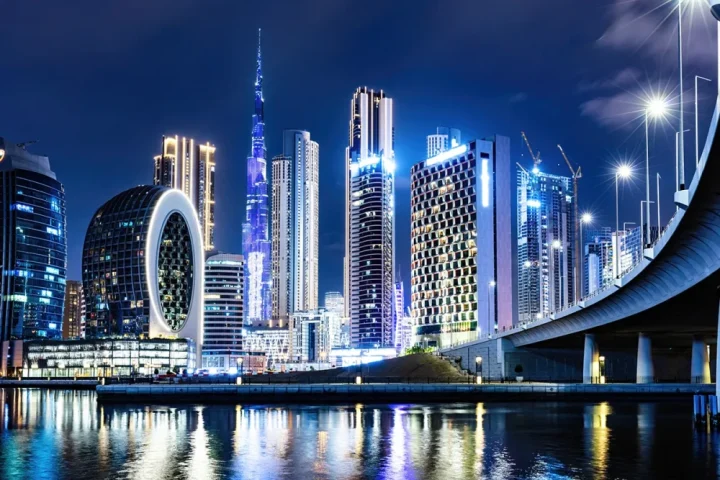
The 430-metre figure creates an eye-catching comparison with Dubai.
Burj Khalifa stands 828 metres tall, meaning Jeddah Tower has now climbed beyond half of the current record-holder’s total height.
However, the comparison needs some context.
Jeddah Tower itself is designed to exceed 1,000 metres. At 430 metres, it has therefore completed roughly 43% of its intended vertical height.
The tower still needs to add more than 570 metres before reaching the kilometre mark.
Even so, passing the halfway point of Burj Khalifa gives the latest construction milestone enormous symbolic value. What was once an unfinished structure on Jeddah’s skyline is visibly becoming a serious challenger to the global height record.
Prince Alwaleed Inspects Jeddah Tower Construction
Kingdom Holding chairman Prince Alwaleed bin Talal has also visited the construction site as work accelerates.
Following the inspection, he said crews had reached 430 metres and reiterated the intention to complete what would become the tallest tower in the world.
The visit provided another public signal that the project remains a major priority for Kingdom Holding and the wider Jeddah Economic City development.
According to the latest figures, construction has accumulated more than 16 million working hours without a lost-time incident and with no fatalities recorded in that period.
For a project involving thousands of workers at extreme heights, construction safety becomes increasingly important as the structure rises.
Jeddah Tower Has Already Passed 100 Floors
Reaching 106 levels comes only months after another milestone.
By April 2026, the project had completed 100 floors, according to structural engineering firm Thornton Tomasetti.
In early June, Jeddah Tower was reported at 102 floors. At the time, New Atlas noted that it had become one of only around 25 buildings worldwide to exceed 100 floors.
The move from around 69 floors in late 2025 to more than 100 floors in 2026 highlights how dramatically the construction pace has changed since work resumed.
For years, the biggest question surrounding Jeddah Tower was whether it would ever be finished.
The conversation is increasingly shifting toward how quickly it can rise.
From a Stalled Megaproject to a Rapidly Growing Tower
Jeddah Tower’s history has been anything but straightforward.
Construction began in 2013, before the project eventually entered a prolonged period of inactivity. Work was later revived, with construction officially gathering momentum again in early 2025.
By November 2025, the building had reached about 69 floors. By June 2026, it was already at 102.
Now, it stands at 106 levels and 430 metres.
That progress has transformed the appearance of the site and revived expectations that Saudi Arabia could finally complete one of the most ambitious skyscraper projects ever attempted.
A 2028 completion has been widely cited for the revived project, although deadlines for developments of this scale can change as construction progresses.
Why Jeddah Tower Will Be Taller Than Burj Khalifa
The final height is what separates Jeddah Tower from virtually every skyscraper built before it.
Architect Adrian Smith + Gordon Gill Architecture says the building will exceed 1,000 metres and contain approximately 530,000 square metres, or 5.7 million square feet, of built space.
Burj Khalifa, by comparison, rises 828 metres.
That means the Saudi tower would stand at least 173 metres higher than its Dubai rival when completed.
Interestingly, there is also a strong architectural connection between the two projects.
Adrian Smith designed Burj Khalifa while working at Skidmore, Owings & Merrill. His later firm, Adrian Smith + Gordon Gill Architecture, designed Jeddah Tower.
In that sense, the building attempting to break Burj Khalifa’s record comes from an architect closely associated with the skyscraper currently holding it.
Engineering a Building More Than One Kilometre High
Reaching one kilometre is not simply a matter of adding more floors.
Wind becomes one of the greatest challenges.
Jeddah Tower uses a three-petal footprint and a continuously tapering form designed to reduce the structural effects associated with wind as it moves around an extremely tall building.
Thornton Tomasetti says its structural system uses interconnected concrete walls, with the structural elements designed to resist both gravity and wind loads.
The foundation is equally extraordinary.
A five-metre-thick concrete raft sits above 270 bored piles. Each pile is about 1.8 metres in diameter, with some extending as deep as 105 metres underground.
Those foundations are necessary to support the immense weight of the kilometre-high structure while dealing with the geotechnical conditions beneath the site.
Jeddah Tower Will Need an Extraordinary Elevator System
Getting people hundreds of metres into the air presents another engineering challenge.
The completed Jeddah Tower complex is designed to contain 59 elevators—54 single-deck and five double-deck units—along with 12 escalators.
Elevators serving the observation areas are planned to travel at around 10 metres per second.
That is roughly 36 kilometres per hour vertically.
Without sophisticated vertical transport, a kilometre-high mixed-use building would be impractical. Residents, office workers, hotel guests and visitors need to travel between different zones without spending excessive amounts of time waiting for lifts.
The elevator system is therefore as important to the building’s functionality as its height is to its global reputation.
Inside the World’s Future Tallest Building
Jeddah Tower is not being designed simply as a giant observation tower.
It will be a mixed-use development containing luxury hospitality, office space, serviced apartments and high-end residential properties.
One of its most dramatic features will be a large sky terrace around level 157.
The terrace is approximately 30 metres across and is planned to form part of what the architects describe as the world’s highest observatory once the building opens.
At that elevation, visitors would experience the Red Sea and Jeddah from a perspective unlike that of almost any existing building.
Jeddah Tower Is Bigger Than One Skyscraper
The project is also intended to act as an anchor for a much larger urban development.
Adrian Smith + Gordon Gill Architecture describes Jeddah Tower as the centrepiece of the broader Kingdom City development near the Red Sea. The surrounding master plan has historically been valued at around $20 billion.
That makes the tower more than a competition for architectural records.
Its developers expect the landmark to stimulate investment and development around the surrounding district, using the skyscraper as an internationally recognisable centrepiece.
Saudi Arabia has increasingly used large-scale tourism, infrastructure and real estate developments as part of its wider economic transformation.
Jeddah Tower could become one of the most visible symbols of that ambition.
Burj Khalifa Still Holds the Crown—for Now
Despite the excitement surrounding Jeddah Tower, Burj Khalifa remains the world’s tallest completed building.
The Dubai skyscraper has held that position since opening in 2010.
Jeddah Tower cannot claim the record simply because its planned height is greater. It has to be completed and measured according to the standards used to rank the world’s tallest buildings.
At 430 metres, it still has hundreds of metres of construction ahead.
That leaves substantial engineering and construction work before the title can change hands.
But the latest milestone makes the challenge increasingly tangible.
Jeddah Tower’s Next Major Test
The progress from around 69 floors in late 2025 to more than 100 levels in 2026 is encouraging, but sustaining that momentum will be crucial.
As the building becomes narrower and higher, construction will enter increasingly specialised stages. Structural work must continue while façade installation, mechanical systems, elevators and interior works advance through lower portions of the skyscraper.
Eventually, attention will shift from floor counts toward something even more significant: the moment Jeddah Tower physically exceeds 828 metres.
That would place the unfinished structure above Burj Khalifa’s architectural height, although the official world-building record would still depend on completion.
Jeddah Tower Moves Closer to Making Skyscraper History
Jeddah Tower’s latest achievement is important because it shows just how far the project has come since its years of uncertainty.
At 106 levels and 430 metres, the tower is already taller than most skyscrapers on Earth. More than 300,000 cubic metres of concrete have been poured, thousands of façade panels are in place and around 6,400 workers are helping push construction upward.
Yet its most extraordinary section has still not been built.
Hundreds of metres remain before the tower reaches its planned height above one kilometre.
That is what makes the coming stages so important.
Burj Khalifa is still the undisputed tallest completed skyscraper in the world. But after years when Jeddah Tower looked like a record-breaking dream that might never be realised, the Saudi project is once again rising rapidly.
The race for the sky is back on—and at 430 metres, Jeddah Tower has just passed one of its clearest landmarks yet.