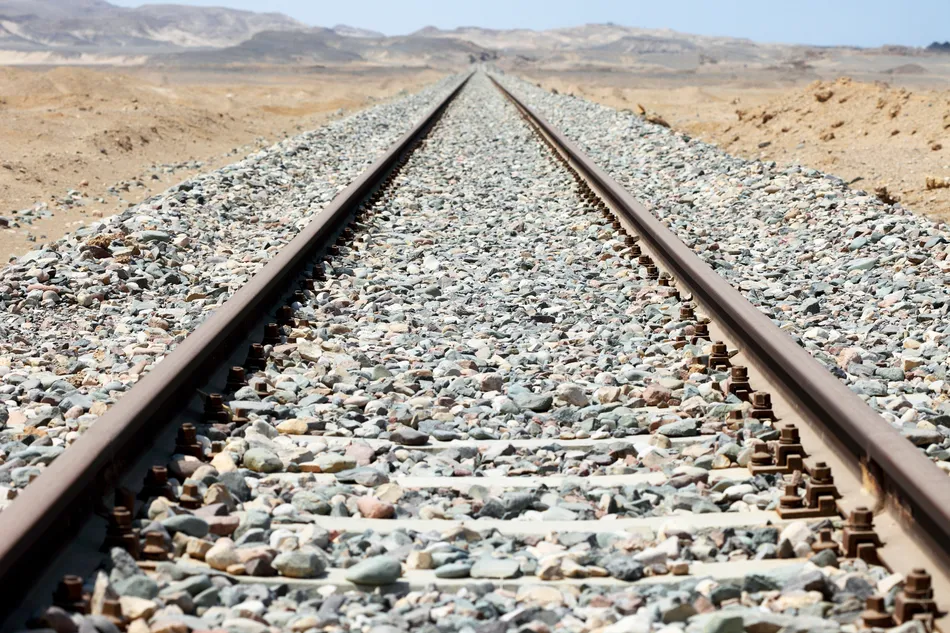
Egypt is accelerating work on a 341-kilometre railway linking Bir al-Abd, Arish and Ras El-Naqab near Taba Airport, aiming to strengthen passenger transport, freight connections and investment across Sinai.
Transport Minister Kamel Al-Wazir inspected construction sites on November 2, reviewing earthworks, track installation and station development. The route forms part of the wider, approximately 500km Firdan–East Port Said–Bir al-Abd–Arish–Taba railway project. sis.gov.eg
The railway is intended to connect residential communities, industrial zones and mining areas with Egypt’s national network, while improving access to ports and logistics facilities.
Sinai railway route: three main sections
The 341km route under construction comprises three main sections, extending from northern Sinai towards the Taba area.
| Railway section | Length |
|---|---|
| Bir al-Abd–Arish | 83km |
| Arish–Hassana | 85km |
| Hassana–Taba area | 173km |
| Total main route | 341km |
The project also includes two separate 12km branch lines: one connecting to Arish Port and another serving a cement factory.
These branches are additional connections to the main route. Their purpose is to give freight users direct access to the railway, linking production and handling facilities with the wider transport network.
Track installation advances between Bir al-Abd and Arish
Al-Wazir’s inspection focused on the 83km Bir al-Abd–Arish section, where 11 Egyptian companies are participating in railway embankment works.
Track installation is progressing along several stretches. The minister instructed contractors to intensify construction while maintaining technical specifications and agreed schedules.
The inspection covered the supporting infrastructure as well as the railway itself. Building a functioning route requires stations, crossings and engineering structures alongside the track.
Construction remains underway, and the reported update did not announce an opening date for the complete 341km line.
Seven stations will serve communities and industrial areas
The minister reviewed progress at seven stations along the northern section:
- El-Sadat.
- El-Toloul.
- Martyrs of Al-Rawda.
- Salt Factory.
- Masaeed.
- Sinai–Central Arish.
- Arish Airport.
The stations are intended to serve villages, residential communities, industrial areas and service facilities.
The project also includes work on nine road-crossing bridges, one railway bridge and two tunnels. These structures form part of the infrastructure needed to accommodate the route and its crossings.
Further inspections covered the Arish–Hassana and Hassana–Taba sections, with Al-Wazir calling for round-the-clock construction to maintain progress.
Freight connections underpin the project’s economic goals
The railway’s proposed role extends beyond passenger travel.
Al-Wazir said it would link Sinai’s industrial and mining areas to the national network and facilitate the movement of products through Arish and Taba ports. Connections with dry ports and logistics zones are also part of the wider development plan.
The dedicated Arish Port branch is particularly relevant to that objective. It is intended to provide a rail connection between the port and inland production areas, while the cement-factory branch will serve a specific industrial facility.
These connections could give businesses additional options for moving raw materials and finished goods. Their practical impact will depend on completed infrastructure and the freight services introduced once the railway becomes operational.
Part of Egypt’s wider Arish–Taba logistics corridor
The railway is a major component of the Arish–Taba integrated development and logistics corridor, one of eight corridors being implemented by Egypt’s Ministry of Transport.
The broader approach connects transport infrastructure with production centres, ports and investment areas. In Sinai, the government expects the railway to support industrial, commercial, mining and tourism activities.
Passenger services are another stated priority. The minister said the project aims to provide residents with safer and faster transport while improving links between communities and the rest of the country.
Those benefits remain project objectives as construction continues.
Remaining sections will extend the restored Sinai connection
The wider programme builds on the first 100km Firdan–Bir al-Abd phase, which restored a railway connection between parts of Sinai and Egypt’s national network.
Work on the remaining route will extend that connection through Arish and towards Taba, alongside the port and industrial branches.
The latest inspection highlights the scale of the work still in progress: track installation, seven stations, multiple bridges and tunnels, and construction across three substantial route sections. Completing those elements will be central to turning the Sinai railway project into an operating passenger and freight corridor.
Read Also: Sam Altman Calls UAE World’s Most Forward-Looking Country for AI Adoption