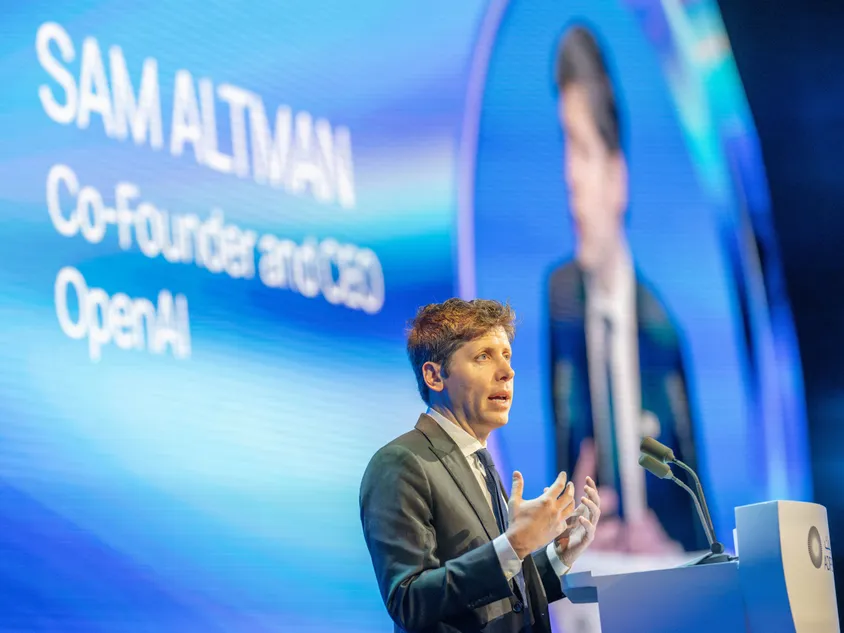
OpenAI CEO Sam Altman has described the UAE as the world’s most forward-looking country for artificial intelligence adoption, praising its embrace of the technology across government and the economy.
Speaking at ADIPEC 2026 in Abu Dhabi, Altman linked that assessment to the country’s willingness to invest in AI and apply it to major industries. His remarks accompanied agreements involving OpenAI, ADNOC and G42, which aim to bring advanced AI capabilities into energy operations. prnewswire.com
The description represents Altman’s assessment of the UAE’s approach, rather than a position awarded by an independent international ranking.
His discussion covered the opportunities and pressures created by AI: changing workplace practices, advances in scientific research, growing electricity demand and the need to preserve human responsibility for decisions.
UAE AI adoption draws praise from OpenAI chief
Altman pointed to the UAE’s commitment to adopting AI following the launch of ChatGPT, highlighting support from the country’s leadership.
He presented that willingness to embrace new technology as an important factor in how countries prepare for economic and technological change.
The energy sector provides a prominent example. The OpenAI, ADNOC and G42 partnership brings together AI development, industrial expertise and infrastructure, with the objective of improving how energy operations are planned and managed.
Altman said the collaboration could help enable changes across the industry. The remarks framed the partnership as an opportunity to apply AI to complex operational challenges, with its eventual impact dependent on implementation.
AI is changing how people work
Altman said tools such as ChatGPT are already helping people perform tasks more efficiently.
He also described a shift in how some users approach the technology. Alongside asking individual questions or requesting assistance with a task, people are increasingly treating AI as a collaborator within a wider workflow.
That distinction matters for workplaces. As AI takes on more connected tasks, organisations must decide how to review its output, assign responsibility and ensure that people retain the knowledge needed to judge its recommendations.
Altman acknowledged that AI can already perform many parts of some white-collar jobs. However, he expressed confidence that societies could adapt to the changes.
His comments concerned tasks within jobs, rather than a claim that every affected occupation could already be fully automated.
Scientific discovery is a major opportunity
Altman identified scientific research as one of the developments that most excites him.
According to WAM’s account of the discussion, he said recent AI systems had begun tackling mathematical problems that people had been unable to solve. He suggested that increasingly capable systems could contribute across scientific fields, including problems relevant to energy production. Emirates News Agency
The potential extends beyond making existing administrative work faster. Research applications could help scientists investigate difficult questions, assess possible solutions and explore new approaches.
Altman’s remarks were an expression of confidence in that direction of development. The supplied account did not provide the technical evidence needed to assess individual mathematical breakthroughs.
Lower energy use per query does not mean lower total demand
Energy availability was another central theme of the discussion.
Altman said improvements in efficiency are reducing the amount of energy needed for an individual AI query. At the same time, lower costs are encouraging people and organisations to use AI more extensively.
Those trends can occur together: each interaction may require less energy while the total number of interactions grows fast enough to increase overall consumption.
For electricity providers and infrastructure planners, this creates a challenge. Efficiency gains matter, but they must be considered alongside the pace of adoption and the scale of computing activity.
The relationship also runs in both directions. AI needs electricity to operate, while energy companies are exploring AI to improve their own systems.
Can AI help offset its own electricity consumption?
Altman said he hoped AI applications in the energy sector would deliver benefits large enough to offset the technology’s own energy requirements and ultimately increase global energy availability.
That is an ambition, rather than a demonstrated outcome of the newly announced partnership.
Potential benefits discussed at ADIPEC included improvements to energy operations and scientific problem-solving. Whether these translate into a net energy benefit will depend on measurable results as applications are developed and deployed.
The discussion places energy infrastructure at the centre of AI’s future: access to reliable power affects how widely the technology can be used, while advances in AI may influence how energy is produced and managed.
Human judgement must remain central
Despite his optimism, Altman stressed that people must retain control over decisions about their future.
He highlighted human creativity and judgement, arguing that AI should serve people as a tool. His position was that growing technical capability should not lead to handing responsibility for society’s direction to AI systems. khaleejtimes.com
For organisations adopting the technology, that makes oversight part of implementation. More capable systems increase the importance of deciding who reviews their work, who can challenge their recommendations and who remains accountable.
The UAE’s energy partnerships will provide a practical setting for these questions as AI moves further into industrial decision-making. Their significance will rest on the results they deliver and the ability of people to understand, supervise and direct their use.
Read Also: Africa Energy Bank Established With $5 Billion Authorised Capital