A Comprehensive Chronicle of Donald Trump’s Rise, Reinvention, and Return to Power
Newton Isaac’s book enters the field of contemporary political biography with a broad and structured examination of Donald Trump’s public life. Spanning several decades, the biography traces Trump’s trajectory through business, media, and politics, placing his career within the wider context of national and international developments. The narrative combines chronological storytelling with analysis of key moments that shaped Trump’s influence in public life. In doing so, the book presents a detailed account of a figure whose actions and leadership have continued to shape political discussion in the United States and abroad, including in Europe and the Middle East.
What distinguishes Isaac’s account is not reverence — nor condemnation — but an encyclopedic immersion into Trump’s long arc, from his immigrant-rooted upbringing in Queens to his reincarnation as America’s 47th president. This is not a reporter’s snapshot or a pundit’s verdict. It is a structural biography that moves through chapters of business, media ascent, political turmoil, post-presidential reinvention, and finally a second administration that Isaac himself describes as “too consequential to leave unrecorded.”
A Blueprint of Ambition: The Foundations of the Trump Persona
Like all serious Trump biographers, Isaac begins in Queens. But while others emphasise the contrarian child or the domineering father, Isaac frames Trump’s childhood through the architecture of inheritance itself—economic, cultural, psychological. Fred Trump looms here not as a mythic patriarch but as the original architect of the Trump operating system: discipline, branding instinct, ethnic street warfare, and a Queens-honed resentment of Manhattan elites.
Isaac writes with corporate precision as he details Trump’s transition from the outer-borough heir to the master builder of the 1980s. The book’s early chapters reconstruct the real estate empire with forensic clarity: the rise of Trump Tower as a personal monument; the risk-taking that led to his boom; the collapse into a $9 billion personal deficit; and the improbable return that recast him as the self-styled “King of Debt”.
The biographer’s tone here is incisive but restrained. He neither mythologises nor moralises. Instead, he positions Trump’s business life as a foundational text — the preamble to a political career steeped in branding logic, dominance games, and a relentless appetite for reinvention.
Television, Spectacle, and the Media Animal
Where many accounts treat The Apprentice as a footnote or cultural sideshow, Isaac spotlights it as the hinge connecting Trump the businessman to Trump the political archetype. The series is not described as entertainment but as a decades-long audition for populist leadership.
Isaac notes how television re-engineered Trump’s public persona: sharpening his cadence, codifying his authority, and giving him the essential grammar of modern political spectacle. He tracks how Trump mastered the camera with the same instincts he once applied to real estate negotiations, becoming—in Isaac’s view—“the first American political figure fully shaped by reality television rather than merely amplified by it.”
This is among the book’s most compelling interpretive through-lines: the idea that Trump did not simply use the media—he adapted to it, survived through it, and eventually weaponised it.
The Presidency: Doctrine, Disruption, and the ‘America First’ Genome
The middle section of Trump Unyielding anchors the biography in Trump’s first term. It is here that Isaac’s balancing act is most pronounced.
He catalogues Trump’s judicial appointments, trade disputes, his confrontational (and sometimes theatrical) global diplomacy, and the controversial domestic policies that ignited both fervent loyalty and severe opposition. Particularly notable is Isaac’s exploration of the Abraham Accords, which he frames not as an anomaly but a natural extension of Trump’s transactional worldview — dealmaking rendered as diplomacy.
He delves into the mechanics behind Trump’s “America First” doctrine, presenting it not merely as a slogan but as a governing ideology: inward-facing, sovereignty-obsessed, and structurally suspicious of international entanglements.
Critics of Trump may expect (or hope for) editorial judgement; Isaac resists. Instead, he positions Trump’s presidency in historical context, allowing the reader to see connections between policy and persona without indulgence in polemic.
The Comedown, the Shadow Presidency, and the Road Back
The chapters documenting the post-2020 period—Trump’s time at Mar-a-Lago, his de facto leadership of the Republican Party, and his “Shadow Presidency” period—are meticulously assembled. Isaac treats the period not as political exile but as a recalibration of influence.
What emerges is Trump not as a fallen figure, but as a political executive without formal office, relying on media, loyalists, and digital platforms to shape discourse from the margins.
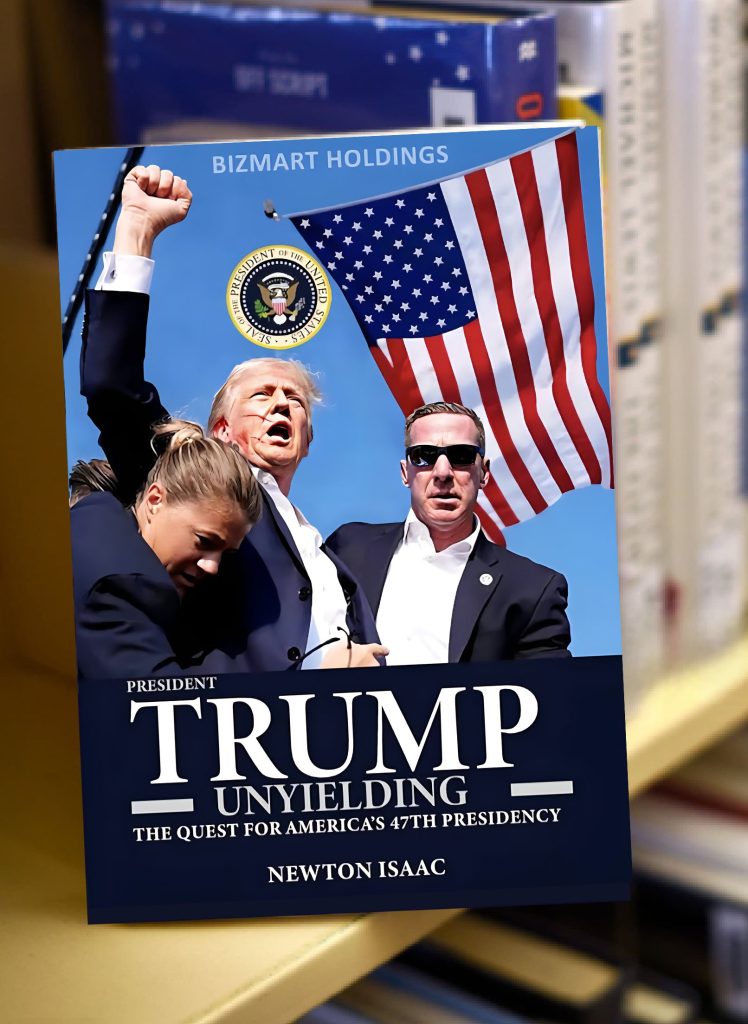
The assassination attempts of 2024 — recounted by multiple reviewers as some of the book’s most gripping pages — add a dramatic weight rarely found in political biographies. Isaac uses them to underline the tension between Trump’s personal vulnerability and his political invincibility—a paradox at the core of Trump’s public mythology.
The Musk Alliance: Convergence of Power and Technology
If the early chapters explore the inheritance of power, the Musk chapters explore its mutation.
Isaac’s treatment of the Trump–Musk alliance feels startlingly contemporary, blending political analysis with meditations on technology, digital free speech, and the merging of political and corporate titans. The partnership is framed as experimental, volatile, and emblematic of a new era in which the lines between governance and innovation blur.
It is one of the book’s distinctive contributions: acknowledging the emerging reality that modern political influence runs increasingly through platforms, algorithms, and adjacent billionaires rather than traditional institutions alone.
A Second Presidency Begins: The Updated Edition
The new preface — added in May 2025 — reframes the entire biography as a living document. Isaac argues that a static narrative cannot contain a presidency still unfolding, and he extends the book to chronicle Trump’s rapid reshaping of domestic and global politics during his first year back in office.
The updated chapter functions almost like a geopolitical audit:
- realignment of alliances
- internal restructuring of federal agencies
- new diplomatic overtures and confrontations
- the rise and fracture of the Musk partnership
- shifting global conflicts influenced by Trump’s diplomacy
This section reads less like biography and more like contemporary history — a shift justified by the author’s stated mission: to document not only who Trump is but also how he governs in real time.
Reception: Enthusiasm, Intrigue, and the Politics of Understanding
The book’s Amazon and international reviews share a striking consistency. Readers from the U.S., UK, and UAE call the book:
- “balanced”
- “deeply researched”
- “the best book about Trump to date”
- “an extraordinary and unforgettable chronicle”
Others highlight its accessibility, narrative clarity, and the sheer density of documented events — from Trump’s business struggles to his near-fatal campaign moments.
The unusual global spread of reviews — and the enthusiasm from readers beyond the American political sphere — suggests that Trump Unyielding has become a kind of reference text, neither devotional nor hostile, but foundational.
A Biography Still in Motion
What makes Trump Unyielding noteworthy is not that it takes a side—most Trump literature does—but that it constructs a long-form, panoramic view of a man who has come to define 21st-century American political identity.
Isaac writes as a biographer but also as an archivist of Trump-era culture, business, media, and governance. His tone is careful, his research evident, and his scope unusually wide. The book does not end; it evolves, much like its subject. For supporters, it is a chronicle of triumph. For critics, a map of influence. For historians, a dataset; for readers, a narrative of one of the most consequential — and contentious — lives in modern national memory.
Trump Unyielding is less a biography than a living record, capturing a political figure who refuses to settle into history because he is still rewriting it.