Trump crypto deal with World Liberty Financial has drawn fresh scrutiny after financial disclosures showed major crypto earnings and Pakistan’s early partnership with the firm became a diplomatic flashpoint.
The controversy centers on World Liberty Financial, a Trump-linked crypto venture, and Pakistan’s agreement to explore use of the firm’s USD1 stablecoin for cross-border payments. The deal has not yet produced a functioning payment system in Pakistan, but analysts argue it gave Islamabad something potentially more valuable: access to senior figures close to the Trump administration.
According to Reuters, Donald Trump reported more than $1.4 billion in income from crypto-related ventures in his 2025 financial disclosure, including large earnings linked to World Liberty Financial. Reuters reported that World Liberty Financial generated $520 million from token sales and $250 million from the sale of business interests.
Trump Crypto Deal Explained
The Trump crypto deal refers to the relationship between Trump-linked World Liberty Financial and Pakistan’s push to explore digital-asset infrastructure.
World Liberty Financial is associated with Donald Trump’s family and became one of the most politically sensitive crypto ventures in the United States after Trump returned to office. Its USD1 stablecoin is designed to maintain a one-to-one value with the US dollar, according to reporting on the Pakistan agreement.
Pakistan signed a memorandum of understanding with SC Financial Technologies, an affiliate of World Liberty Financial, in January 2026. Reuters reported that the agreement was designed to explore the use of a dollar-pegged stablecoin for cross-border payments and digital payment infrastructure.
On paper, the arrangement looked like a fintech cooperation deal. Politically, it became much more important because it connected Pakistan to a Trump-linked business network at a time when Islamabad was seeking stronger access to Washington.
Why the Deal Became Controversial
The deal became controversial because it sits at the intersection of politics, diplomacy, crypto regulation and presidential financial interests.
Trump’s financial disclosure showed that crypto had become a major source of income. Reuters reported more than $1.4 billion in crypto-related income, while Al Jazeera reported that World Liberty Financial was part of a wider crypto windfall connected to Trump’s 2025 disclosures.
At the same time, Pakistan’s partnership with a Trump-linked firm raised questions about whether a commercial crypto agreement helped Islamabad gain diplomatic access.
Al Jazeera reported that analysts viewed Pakistan’s engagement with World Liberty Financial as a diplomatic bet that gave Pakistan greater access to the White House.
The White House has denied conflicts of interest around Trump’s relationship with crypto ventures, according to reporting on the financial disclosures and related controversy.
Pakistan’s Agreement With World Liberty Financial
Pakistan’s agreement involved SC Financial Technologies, an affiliate of World Liberty Financial.
Reuters reported that Pakistan signed the memorandum of understanding with SC Financial Technologies to explore use of the USD1 stablecoin for cross-border payments. The deal was announced by Pakistan’s Virtual Asset Regulatory Authority.
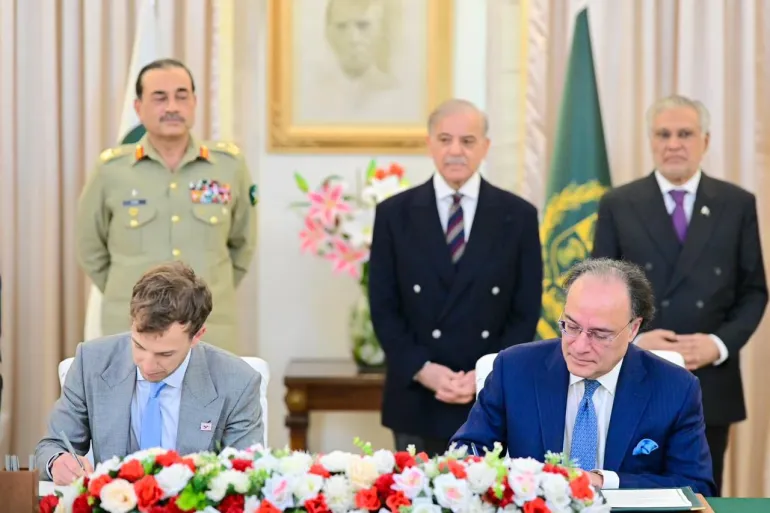
Central Banking reported that the memorandum was signed on January 14, 2026, by Pakistan’s finance minister Muhammad Aurangzeb and Zach Witkoff, co-founder and chief executive of World Liberty Financial and son of US special envoy Steve Witkoff.
The agreement was framed as technical cooperation around digital finance. It did not automatically authorize USD1 operations in Pakistan or create a fully functioning stablecoin payment system.
That distinction matters. A memorandum of understanding is usually a starting point for cooperation, not a final commercial launch.
What USD1 Is Supposed to Do
USD1 is a stablecoin connected to World Liberty Financial.
A stablecoin is a digital token designed to maintain a stable value, often by being pegged to a traditional currency such as the US dollar. In this case, USD1 is described as a dollar-linked stablecoin.
The proposed use case in Pakistan was cross-border payments. That means the token could theoretically be used to move value across borders faster or more cheaply than some traditional channels.
However, stablecoin use in regulated financial systems requires legal approval, banking access, compliance systems, anti-money-laundering controls, consumer safeguards and technical integration.
Pakistan’s agreement with World Liberty Financial did not mean USD1 had already become part of the country’s mainstream financial system.
No Clear Evidence of Operational Use Yet
Despite the political attention, there is no clear evidence that USD1 has gained meaningful operational use in Pakistan.
Reuters described the agreement as exploratory and focused on potential integration with regulated digital payment infrastructure.
Pakistan’s own regulatory system also shows that full licensing remains a process. PVARA says the Virtual Assets Act, 2026 created the country’s first comprehensive legal framework for overseeing virtual assets and virtual asset service providers.
PVARA’s licensing page states that virtual asset service providers must obtain a formal license before offering services in Pakistan, while the authority is currently accepting applications for No Objection Certificates and says the full licensing framework will be available soon.
That means any stablecoin operation would still need to fit within Pakistan’s evolving licensing framework.
Pakistan’s Crypto Market Position
Pakistan is already one of the world’s major crypto markets by adoption.
The user-provided source text says Pakistan ranked third globally for crypto adoption behind India and the United States, citing Chainalysis. That detail fits the wider point that Pakistan has a large and active digital-asset user base.
This matters because Pakistan is not entering crypto from zero. It already has a large informal or semi-formal crypto user population, active retail demand and significant remittance interest.
However, widespread crypto adoption does not automatically translate into government approval for a particular stablecoin.
Analysts quoted in the source text argue that most practical crypto activity in Pakistan still appears to involve more established stablecoins such as Tether’s USDT rather than USD1.
Pakistan’s Virtual Assets Act
Pakistan has moved quickly to create a legal framework for digital assets.
PVARA says the Virtual Assets Act, 2026 introduced Pakistan’s first comprehensive framework for virtual assets and virtual asset service providers. The authority is responsible for licensing, supervising and regulating virtual asset businesses operating in the country.
PVARA also opened public consultation on Virtual Asset Services Regulations, 2026. The consultation notice says the Act requires all virtual asset service providers to be licensed before offering services in Pakistan.
This regulatory shift is important because it creates a formal pathway for crypto businesses. It also gives Pakistan a mechanism to decide which companies can legally operate.
For World Liberty Financial or any other crypto company, the key question is not only political access. It is whether the company can meet Pakistan’s licensing and compliance requirements.
State Bank of Pakistan’s Banking Guidance
Pakistan’s central bank has also adjusted its position toward licensed virtual-asset businesses.
The State Bank of Pakistan issued a circular on April 14, 2026, allowing regulated entities to open bank accounts for businesses duly licensed by PVARA as virtual asset service providers, subject to strict compliance conditions.
Dawn also reported that SBP-regulated entities may open bank accounts for PVARA-licensed virtual asset service providers, with verification and compliance requirements.
This is a major step because crypto firms often struggle to access banking services.
However, the permission applies to licensed entities. It does not mean every crypto firm can automatically operate or obtain banking access.
Why Pakistan Was Interested
Pakistan had several reasons to explore stablecoin infrastructure.
First, cross-border payments and remittances are economically important. Millions of Pakistanis abroad send money home, and faster or cheaper systems could be attractive.
Second, Pakistan has a large crypto user base. A regulated framework could bring some activity into formal channels.
Third, digital assets offer Pakistan a way to signal financial modernization to global investors and technology partners.
Fourth, and perhaps most politically important, cooperation with a Trump-linked firm created an opening to strengthen ties with Washington.
This is why the agreement can be read in two ways: as a fintech experiment and as a diplomatic strategy.
The Diplomatic Dimension
The diplomatic dimension may be the most important part of the story.
Al Jazeera reported that Pakistan’s engagement with World Liberty Financial helped the country gain clout with the Trump administration, even though the partnership had not produced operational crypto projects.
The timing matters. Pakistan was trying to improve ties with the United States while navigating regional tensions and economic pressure.
A commercial agreement with a firm linked to the US president’s family created a direct line into a powerful political network.
Even if no stablecoin pilot succeeds, the relationship may already have delivered diplomatic benefits.
Why Analysts Say Pakistan Benefited
Analysts argue Pakistan benefited because the agreement created access.
In diplomacy, access can be valuable even before policy outcomes are visible. A meeting, a communication channel or a direct relationship with influential figures can shape future negotiations.
The source text notes that Pakistani officials and analysts viewed the crypto relationship as part of a broader effort to rebuild trust with the Trump administration.
That does not mean the stablecoin itself has succeeded. It means the agreement may have functioned as a diplomatic bridge.
This is why some observers describe the transaction as politically more successful than commercially successful.
Commercial Questions Remain
The commercial value of the arrangement remains unclear.
For USD1 to become useful in Pakistan, it would need regulatory approval, banking integration, user adoption, merchant or institutional acceptance and cross-border counterparties willing to use it.
A stablecoin cannot solve cross-border payment challenges by name alone. It needs infrastructure, liquidity, trust, compliance and acceptance.
If Pakistan’s trading partners or remittance channels do not accept USD1, the stablecoin may still need to be converted into dollars or local currency through traditional financial channels.
That could reduce the practical advantage.
This is why analysts remain cautious about the economic value of the deal.
Why Stablecoins Are Politically Sensitive
Stablecoins are politically sensitive because they sit between private money, digital payments and national financial systems.
A stablecoin pegged to the US dollar can be used for payments, savings, trading or cross-border transfers. If widely adopted, it can influence how people hold and move value.
For countries with currency pressure or high remittance flows, dollar-backed stablecoins can become attractive.
However, they also raise concerns. Regulators worry about money laundering, consumer protection, capital flight, monetary control and financial stability.
When a stablecoin is linked to a politically powerful family, the concerns become even sharper.
That is why the Trump crypto deal has drawn attention beyond ordinary fintech reporting.
Trump Family Financial Windfall
Trump’s crypto earnings became a major part of the controversy.
Reuters reported that Trump’s 2025 financial disclosure showed more than $1.4 billion in income from crypto ventures, including $520 million from World Liberty Financial token sales and $250 million from the sale of business interests.
Business Insider also reported that Trump’s crypto ventures generated more than $1 billion in income, with World Liberty Financial among the major sources.
These figures intensified questions about conflicts of interest because Trump was not only a political leader but also financially connected to a crypto business that was seeking international adoption.
Supporters argue that the ventures are disclosed and lawful. Critics argue that the arrangement creates an unusual overlap between public power and private gain.
Conflict-of-Interest Debate
The conflict-of-interest debate is central to the story.
Critics say Trump’s crypto ventures blur the line between public office and private business. They argue that foreign governments or companies may have incentives to engage with Trump-linked firms to gain political favor or access.
The White House has denied conflicts of interest, according to reporting on the disclosures.
This debate is likely to continue because crypto regulation became a major policy area during Trump’s return to office.
When a president’s family business benefits from a regulated industry, every policy decision involving that industry can attract scrutiny.
Pakistan’s agreement with World Liberty Financial therefore became part of a larger ethics debate in Washington.
Pakistan’s Regulatory Balancing Act
Pakistan faces a difficult regulatory balancing act.
On one hand, the country wants to modernize payments, attract digital-asset investment and bring crypto activity under formal supervision.
On the other hand, it must protect financial stability, prevent illicit finance, manage currency risks and avoid becoming dependent on politically sensitive foreign crypto firms.
The Virtual Assets Act and PVARA licensing process are designed to create order in the sector.
The key test will be whether Pakistan applies the same licensing standards to all firms, including politically connected ones.
If regulation is fair and transparent, the country can build credibility. If access appears politically driven, confidence could suffer.
Why Remittances Matter
Remittances are one of Pakistan’s most important financial flows.
A stablecoin payment system could theoretically make remittances faster or cheaper, but only if it integrates with banks, wallets, foreign exchanges, compliance systems and cash-out channels.
The source text quotes financial experts questioning whether USD1 solves an urgent problem when Pakistan already receives large remittance inflows through conventional banking channels.
This is a valid concern. Crypto payment tools often promise efficiency, but the real challenge is the full payment chain.
A remittance is not complete when a token moves. It is complete when the recipient receives usable money safely, cheaply and legally.
Why Tether Still Dominates
The source text notes that most crypto activity in Pakistan reportedly continues to involve Tether’s USDT rather than USD1.
This matters because stablecoin markets tend to favor liquidity and network effects.
Users choose the token that exchanges accept, traders use, wallets support and markets trust. New stablecoins must overcome that existing dominance.
USD1 may have political visibility, but practical adoption requires market depth.
Unless exchanges, remittance channels, merchants and financial institutions support it, its use may remain limited.
This is one reason the Pakistan partnership remains more symbolic than operational for now.
The Role of Zach Witkoff
Zach Witkoff played a visible role in the Pakistan agreement.
Central Banking reported that the January 2026 memorandum was signed by Pakistan’s finance minister Muhammad Aurangzeb and Zach Witkoff, co-founder and CEO of World Liberty Financial.
Reuters also reported that Zach Witkoff visited Pakistan and met senior officials to discuss digital financial infrastructure.
His role matters because of his connection to Steve Witkoff, a Trump adviser and envoy.
That connection helped turn a stablecoin memorandum into a diplomatic story.
For Pakistan, engagement with World Liberty Financial was not only engagement with a crypto company. It was engagement with a network close to the White House.
Pakistan’s Diplomatic Strategy
Pakistan’s diplomatic strategy appears to have been pragmatic.
The country used crypto cooperation to position itself as open to financial innovation while creating a channel to influential Trump-linked figures.
This strategy may have helped Islamabad at a time when it wanted to improve relations with Washington.
The source text notes that Pakistani officials and analysts viewed the crypto strategy as a way to rebuild trust and open diplomatic opportunities.
Whether one sees this as smart diplomacy or troubling influence politics depends on perspective.
What is clear is that the crypto deal became more than a technical financial agreement.
What the Deal Means for World Liberty Financial
For World Liberty Financial, the Pakistan deal offered international legitimacy.
A memorandum with a sovereign government can help a crypto firm signal credibility, especially if it is trying to expand use of a stablecoin.
Reuters described the agreement as one of World Liberty’s first public collaborations with a sovereign nation.
That kind of partnership can be valuable for branding, investor confidence and future negotiations.
However, symbolic partnerships do not guarantee adoption.
World Liberty Financial still needs actual use cases, regulatory approvals and market acceptance if USD1 is to become commercially meaningful.
What the Deal Means for Pakistan
For Pakistan, the deal offered both opportunity and risk.
The opportunity was access: access to a Trump-linked business network, access to digital-finance expertise and access to a potential role in the global stablecoin conversation.
The risk is reputational and regulatory. If the agreement is seen mainly as political access-seeking, critics may question whether Pakistan’s crypto policy is being shaped by national interest or diplomatic calculation.
There is also financial risk if Pakistan adopts a stablecoin without proper safeguards.
For now, the deal remains exploratory. That gives Pakistan time to build rules before allowing full operations.
What the Deal Means for the United States
For the United States, the deal highlights the difficulty of separating private crypto interests from public diplomacy.
If foreign governments engage with companies linked to a sitting president’s family, ethical questions become unavoidable.
The issue is not only whether a law was broken. It is whether foreign actors may believe commercial engagement can improve political access.
That perception alone can damage public trust.
The Trump administration’s pro-crypto policy environment adds another layer of scrutiny.
When policy decisions benefit an industry connected to presidential family income, critics will keep asking whether public and private interests are too closely aligned.
Why This Story Matters Globally
This story matters globally because it shows how crypto can become a tool of diplomacy.
Stablecoins are not only financial products. They can become instruments of influence, access and geopolitical positioning.
Countries looking for financial modernization may partner with crypto firms. Crypto firms may seek sovereign partners for legitimacy. Politically connected firms may offer both technology and access.
That combination creates opportunities and risks.
For developing economies, the challenge is to benefit from financial innovation without becoming vulnerable to political or commercial capture.
Pakistan’s experience may become a case study in that balance.
Key Risks to Watch
Several risks remain.
The first is regulatory risk. Pakistan’s licensing framework is still developing, and no stablecoin can operate meaningfully without clear rules.
The second is adoption risk. USD1 may not gain market share if users prefer established stablecoins.
The third is compliance risk. Cross-border stablecoin payments must address anti-money-laundering, counter-terror-financing and consumer-protection concerns.
The fourth is political risk. The Trump connection could keep the deal under scrutiny in both Pakistan and the United States.
The fifth is financial-stability risk. Widespread use of dollar-backed stablecoins can affect local currency systems if not properly supervised.
Key Opportunities to Watch
There are also opportunities.
Pakistan could use its new regulatory framework to bring crypto businesses into formal supervision. That may improve transparency and reduce informal-market risks.
Stablecoin technology could help test faster cross-border payment models if implemented safely.
Pakistan could also attract fintech investment if it creates clear rules and treats firms equally.
For World Liberty Financial, Pakistan could become a showcase market if USD1 is eventually approved and used.
For Washington and Islamabad, the relationship could support broader dialogue beyond crypto.
But these opportunities depend on implementation, not headlines.
What Happens Next
The next stage depends on regulation and real-world adoption.
PVARA is still moving through consultation and licensing processes. Its licensing page says No Objection Certificate applications are currently being accepted, with a full licensing framework to be made available soon.
Any meaningful USD1 rollout would likely require PVARA approval, State Bank coordination, banking access, compliance systems and technical integration.
Until that happens, the World Liberty Financial agreement remains mostly symbolic.
The diplomatic gains may already have happened, but the commercial results remain unproven.
Conclusion: Trump Crypto Deal Was More Diplomatic Than Commercial
The Trump crypto deal with Pakistan shows how digital assets can become part of international diplomacy.
World Liberty Financial gained attention after Trump’s 2025 financial disclosure showed major crypto-related income, including large sums linked to the firm’s token sales and business interests. Pakistan, meanwhile, became one of the first sovereign partners to explore cooperation with a World Liberty Financial affiliate.
The agreement focused on possible use of the USD1 stablecoin for cross-border payments, but there is still no clear evidence of meaningful operational use in Pakistan. The country’s crypto regulatory framework is still being finalized through PVARA, and virtual asset service providers must obtain proper licensing before offering services.
For Pakistan, the greater value appears to have been diplomatic access. Analysts argue that the partnership helped Islamabad strengthen ties with figures close to the Trump administration at a sensitive time in regional politics.
For World Liberty Financial, the deal provided international visibility and a potential pathway into a major crypto market.
For critics, the arrangement raises serious questions about conflicts of interest, foreign influence and the blurred line between public power and private crypto wealth.
What to watch next is whether Pakistan grants full licenses to crypto firms, whether USD1 gains any real use in cross-border payments, and whether the Trump-linked crypto empire continues to shape diplomatic relationships as much as financial markets.
Read Also: 148 Foreign Investors Bring $5.3bn to Saudi Private Markets