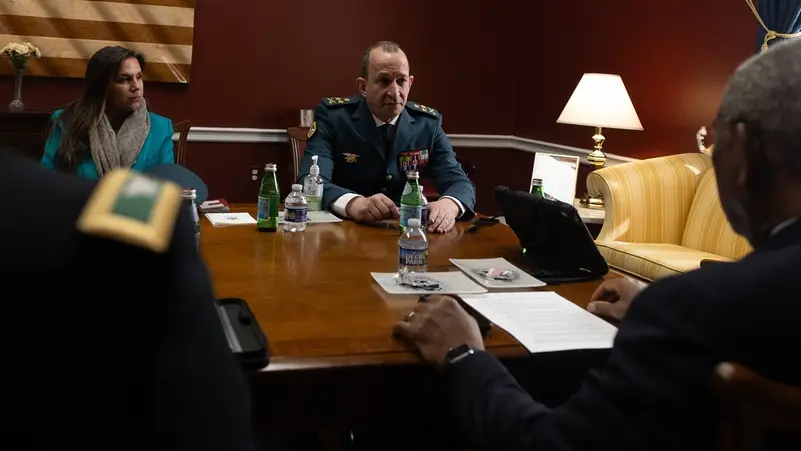
Lebanon’s top military commander wrapped up a high-level visit to Washington after holding a series of largely constructive meetings with US officials, even as sharp criticism from a senior Republican senator cast a shadow over future American military assistance to Beirut.
Rodolphe Haykal, commander of the Lebanese Armed Forces, spent several days engaging with US defense and security leaders to reinforce cooperation and reassure Washington about the army’s role in maintaining internal stability. While many of those discussions were described as positive, Haykal’s outreach encountered resistance on Capitol Hill that underscored deep political divisions in the United States over Lebanon policy.
A brief meeting sparks controversy
The most public friction emerged after an encounter with Lindsey Graham, a senior Republican senator and close ally of Donald Trump. Graham said he abruptly ended what he described as a very short meeting after pressing Haykal on whether the Lebanese army views Hezbollah as a terrorist organization.
According to Graham, Haykal responded that the group is not considered a terrorist organization “in the context of Lebanon,” a statement that immediately drew condemnation from the senator. Graham pointed to the 1983 US Marine barracks bombing in Beirut, an attack attributed to Hezbollah’s predecessor, as evidence of the group’s long-standing designation as a terrorist organization under US law.
In a public post, Graham said the exchange reinforced his doubts about the Lebanese military as a reliable partner, arguing that ambiguity toward Hezbollah undermines trust at a time of heightened regional risk.
Longstanding frustrations resurface
Graham’s remarks echoed frustrations that have been building among some US lawmakers for years. Several members of Congress had already canceled a planned visit to Lebanon last year, citing dissatisfaction with what they viewed as limited progress by the Lebanese army in curbing Hezbollah’s influence and enforcing state authority over weapons.
These concerns have repeatedly fueled debate over whether continued US military aid to Lebanon strengthens state institutions or indirectly benefits a powerful armed group Washington considers a major security threat.
Haykal emphasizes internal security mandate
Speaking at a public forum during the visit, Haykal sought to clarify the Lebanese army’s position. He stressed that the force’s overriding mission remains safeguarding internal security and preventing Lebanon from sliding further into instability amid economic collapse and political paralysis.
Haykal also reaffirmed the Lebanese government’s stated commitment to bringing all weapons under state control, including those held by Hezbollah. He framed this objective as a long-term process that depends on political consensus and institutional strength rather than unilateral military action.
Mixed reception on Capitol Hill
Despite the criticism from Graham, Haykal’s reception in Washington was far from uniformly negative. A day before the contentious exchange, he met with Jeanne Shaheen, the top Democrat on the Senate Foreign Relations Committee. Shaheen reportedly struck a more optimistic tone, emphasizing the importance of continued engagement with the Lebanese army as a stabilizing force in a volatile region.
Haykal also held discussions with senior lawmakers on the House Foreign Affairs Committee, including Chairman Brian Mast and Ranking Member Gregory Meeks, signaling that congressional views on Lebanon remain divided along both partisan and strategic lines.
Broad security engagement beyond Congress
Beyond Capitol Hill, Haykal’s schedule reflected Washington’s continued institutional engagement with Lebanon’s military leadership. He met separately with officials at the Central Intelligence Agency, the National Security Council, and the Pentagon.
At the Pentagon, Haykal held talks with Dan Caine, focusing on military cooperation and regional security challenges. His first stop during the US trip was United States Central Command headquarters in Tampa, Florida, where discussions centered on coordination and the Lebanese army’s operational needs.
Aid questions linger as visit concludes
Haykal’s Washington visit highlighted a familiar tension in US-Lebanon relations: broad support within the US executive branch and parts of Congress for sustaining the Lebanese army, paired with skepticism from lawmakers who see Hezbollah’s influence as a disqualifying factor.
As Lebanon continues to grapple with economic crisis and political deadlock, the debate over whether and how the United States should support its armed forces remains unresolved, with Haykal’s mixed reception reflecting the complex calculus shaping Washington’s approach.