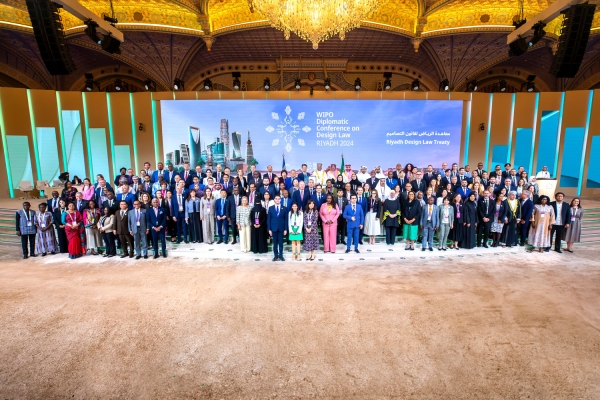
The Riyadh Design Law Treaty is an international agreement that establishes a legal framework for protecting designers’ rights and ensuring the safeguarding of creative works across multiple jurisdictions. It was formally adopted in Riyadh, Saudi Arabia, during the WIPO Diplomatic Conference on the Design Law Treaty in November 2024, with the participation of all 193 member states of the World Intellectual Property Organization (WIPO).
This treaty simplifies design protection procedures worldwide, making it easier and more cost-effective for designers, innovators, and enterprises to register and protect their works across borders.
Adoption
The Riyadh Design Law Treaty was officially adopted during the Diplomatic Conference on the Design Law Treaty, hosted by the Saudi Authority for Intellectual Property (SAIP) at the King Abdulaziz International Conference Center in Riyadh from November 11 to 22, 2024.
The selection of Riyadh as the host city, and the naming of the treaty after it, underscores Saudi Arabia’s growing role as a hub for cultural exchange, innovation, and intellectual property leadership. It reflects the Kingdom’s contributions to international cooperation in intellectual property protection.
History
The adoption of the treaty was the result of nearly two decades of discussions and negotiations:
- 2005 – Initial decision to simplify design registration procedures.
- 2006 – Publication of an information document on formalities related to design registration.
- 2010 – Discussions on areas of convergence in design law and practices.
- 2011 – Drafting provisions for design law began.
- 2015 – WIPO General Assembly directed the Standing Committee to finalize a proposal text.
- 2016 – Drafting of industrial design provisions and regulatory rules.
- 2023 – Saudi Arabia won the bid to host the diplomatic conference.
- 2024 – Saudi Arabia hosted and presided over the diplomatic conference, leading to the adoption of the treaty under the official name Riyadh Design Law Treaty.
Significance
The Riyadh Design Law Treaty is significant for its role in:
- Facilitating registration of creative works worldwide.
- Reducing costs for small designers and SMEs, enabling broader participation in global markets.
- Supporting traditional knowledge and cultural expressions, ensuring that heritage designs are respected and protected.
- Enhancing cooperation between WIPO member states on harmonizing design law and practices.
By lowering procedural barriers, the treaty strengthens global intellectual property systems and encourages innovation in creative industries.
Objectives
The treaty aims to:
- Promote international cooperation in the protection of creative works.
- Establish a legal environment that supports creativity, innovation, and cultural preservation.
- Protect the rights of designers, enabling them to compete fairly in global markets.
- Encourage the growth of creative industries worldwide, aligning with sustainable development goals.
- Reinforce Saudi Arabia’s role in shaping a global framework for design protection.
Global Impact
The Riyadh Design Law Treaty supports designers, innovators, and businesses across WIPO’s 193 member states by creating a unified system for design protection. It particularly benefits micro, small, and medium enterprises (MSMEs) by reducing costs, simplifying procedures, and enabling broader access to international markets.
The treaty also strengthens the recognition of cultural heritage and traditional designs, ensuring that they are legally protected from misuse or exploitation.