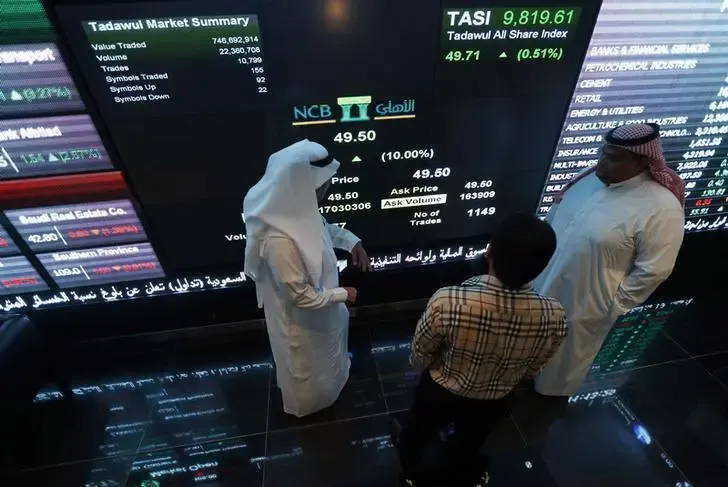
The recent Saudi stock market correction has made equity valuations more attractive, according to Al Rajhi Capital, which argues that lower prices are offering investors better compensation for the risks facing the market.
In a research note reported by Zawya, the firm pointed to the combination of reduced valuations and resilient domestic fundamentals as reasons for a more constructive outlook.
The assessment follows a sharp October decline in the Tadawul All Share Index, or TASI, against a backdrop of geopolitical uncertainty and concerns about near-term corporate earnings. Al Rajhi Capital’s position is that the sell-off has improved the investment case—not that the risks have disappeared. ZAWYA
TASI’s October Decline Pushes Valuations Lower
According to the figures cited in the research note, TASI lost slightly more than 1,000 points in roughly two weeks through October 25, reaching levels last seen in 2021.
The index rebounded on October 26. Argaam reported a 3.4% gain that day, equivalent to 323 points, taking TASI to 9,762 points. The advance followed five consecutive declining sessions. argaam.com
The research note nevertheless described the market as approximately 7% lower year to date and 24% below its 2024 highs around that period.
Those figures are a dated snapshot of the correction discussed in the note, rather than live market readings.
Saudi Equities’ Emerging-Market Premium Narrows
A central part of Al Rajhi Capital’s argument concerns the valuation premium investors pay for Saudi shares.
The firm said TASI’s trailing price-to-earnings ratio had returned to levels last seen in 2018. It also reported that the market’s valuation premium over MSCI Emerging Markets had narrowed to 6%, compared with a 24% long-term average and a 60% peak in 2022.
| Valuation Measure | Figure Cited in the Note |
|---|---|
| Saudi market premium over MSCI Emerging Markets | 6% |
| Long-term average premium | 24% |
| Premium reached in 2022 | 60% |
| Historical comparison for TASI’s trailing P/E | Levels last seen in 2018 |
The comparison suggests investors are paying a much smaller relative premium for Saudi equities than in earlier periods.
However, a smaller premium is not the same as a discount. At a positive 6% premium, Saudi shares remain more expensive on the cited valuation measure than the emerging-market benchmark.
What Lower Price-to-Earnings Ratios Mean
A trailing price-to-earnings ratio compares share prices with earnings already generated.
When share prices fall without a corresponding decline in reported earnings, the ratio becomes lower. That can make equities appear less expensive, but it does not establish that future returns will improve.
The outlook for profits remains important. If earnings subsequently weaken, a valuation based on past profits may provide an incomplete picture.
Al Rajhi Capital’s positive assessment therefore rests on more than falling prices. Its argument also depends on the resilience of Saudi businesses and the economy supporting future earnings.
Market Performance Has Diverged From Oil Prices
The research house said TASI had diverged from oil prices, interpreting the separation as evidence that investors were placing greater weight on geopolitical risk and near-term earnings than on longer-term fundamentals.
That distinction matters because a supportive oil market does not automatically translate into rising share prices.
Investors may still reduce exposure if they expect higher operating costs, weaker profits or greater disruption. Different sectors can also respond differently to changes in energy prices and domestic activity.
For Al Rajhi Capital, the divergence helps explain why valuations have fallen despite sources of support elsewhere in the economy.
Economic Resilience Supports the Research House’s Outlook
Al Rajhi Capital highlighted Saudi Arabia’s economic and operational resilience as an important source of confidence.
It specifically pointed to Saudi Aramco’s diversified export infrastructure and operational flexibility, arguing that these capabilities help the company adapt to changing conditions.
That is part of the research house’s broader case that short-term market uncertainty should be weighed against the ability of major businesses to continue operating through disruption.
It does not imply that every Saudi-listed company faces the same opportunities or has the same capacity to absorb shocks.
Oil Inventory Rebuilding Could Provide Additional Support
The firm also expects the replenishment of depleted oil inventories to support demand and prices over an extended period.
The underlying argument is that rebuilding stocks could add to ordinary consumption requirements, creating another source of demand.
However, that remains an outlook rather than a guaranteed development. The pace of replenishment, supply availability and wider economic conditions would influence the effect on oil prices.
The significance for Saudi equities would also vary by company and sector rather than translate uniformly across the market.
Uncertainty Remains Despite More Attractive Valuations
Al Rajhi Capital’s assessment acknowledges continuing uncertainty. A lower entry valuation can improve the balance between risk and potential return without preventing further declines.
Subsequent trading illustrates that volatility has not disappeared. Reuters reported that Saudi Arabia’s benchmark fell about 1% on October 29 amid regional conflict concerns, although it finished the week higher and ended an eight-week losing streak. reuters.com
The research note is therefore best understood as a valuation argument rather than a prediction that the market has reached a definitive bottom.
The next test will be whether corporate earnings and operating conditions support the resilience Al Rajhi Capital expects. Lower prices have changed the starting point for investors; the strength and durability of future profits will determine whether those valuations prove attractive.
Read Also;From UAE Gold Hub to Nasdaq: Metra and GoldCoin Labs Open New Chapter in Digital Gold Finance