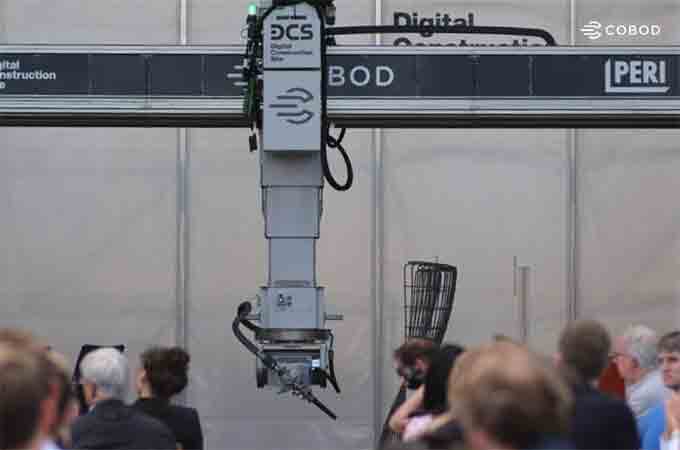
Braunschweig, Germany – In a major technological leap for the global construction industry, COBOD International, in partnership with Technische Universität Braunschweig, has launched the world’s first commercially available multifunctional construction robot.
The innovative system, developed collaboratively with the university’s Institute for Structural Design (ITE), is built upon COBOD’s advanced 3D construction printing technology. It features a vertical telescopic unit combined with a robotic arm, enabling support for the Shotcrete 3D Printing Process (SC3DP) — a technique used for fabricating complex concrete structures such as tunnels, retaining walls, swimming pools, and for reinforcing infrastructure.
Versatile Telescopic Tool Beyond Shotcrete
The system isn’t confined to shotcrete applications. COBOD’s BOD2 3D printer has been upgraded with a versatile telescopic extension tool, capable of mounting various functional attachments. This turns the setup into a multi-purpose robot, supporting tools such as paint sprayers, insulation tools, and sanding devices — expanding its role far beyond simple wall printing.
This enhanced configuration was unveiled during the Grand Opening of the Digital Construction Site at TU Braunschweig, showcasing Germany’s commitment to digitized and automated building technologies.
Helga Kühnhenrich, head of Research and Innovation in Construction at BBSR, was present at the launch, signaling strong governmental backing for innovation in construction to meet rising urban and housing demands.
Digital Fabrication of Complex Concrete Forms
The multifunctional robot is being deployed by TU Braunschweig for fabricating reinforced, double-curved concrete walls with high surface fidelity and design flexibility. Reinforcement can be inserted post-print or pre-shaped and shotcreted from both sides. The robotic arm can also be equipped for surface finishing, integrating function and form.
Professor Harald Kloft, Head of Structural Design at ITE, stated:
“Our partnership with COBOD is a decisive step toward the digital construction site of the future. This system allows for automated production of complex, material-efficient structures with minimal waste.”
He emphasized the synergy of economic efficiency, environmental sustainability, and worker safety that 3D printing technology brings to the construction industry.
Redefining Robotic Capabilities in Construction
With a vertical reach of 3 meters, the robotic arm can manipulate and finish printed walls well below the main X-axis, offering unparalleled operational flexibility. This makes the robot suitable for not just construction but also for painting, insulating, sanding, and potentially more tasks with the right tool extensions.
According to COBOD, the breakthrough aims to reduce labor dependency and cut construction costs by maximizing automation and precision. It’s a pivotal moment in transforming traditional construction into a digitally driven, adaptive, and efficient process.
Source: The Arabian Wall Street